
When you compare personal loans in the UAE, you'll want to know how much you need to pay each month and whether that payment fits your budget. The interest rate helps you understand the cost, but you also need to check how the bank calculates it.
You may see a lower rate on one offer and a higher rate on another, yet find that their monthly payments are similar. One bank could be quoting a flat rate while the other quotes a reducing rate.
The difference comes down to how much of your loan the bank uses to work out the interest. Once you understand that, you can ask for the payment details you need to compare the offers.
What is the difference between flat and reducing interest rates?
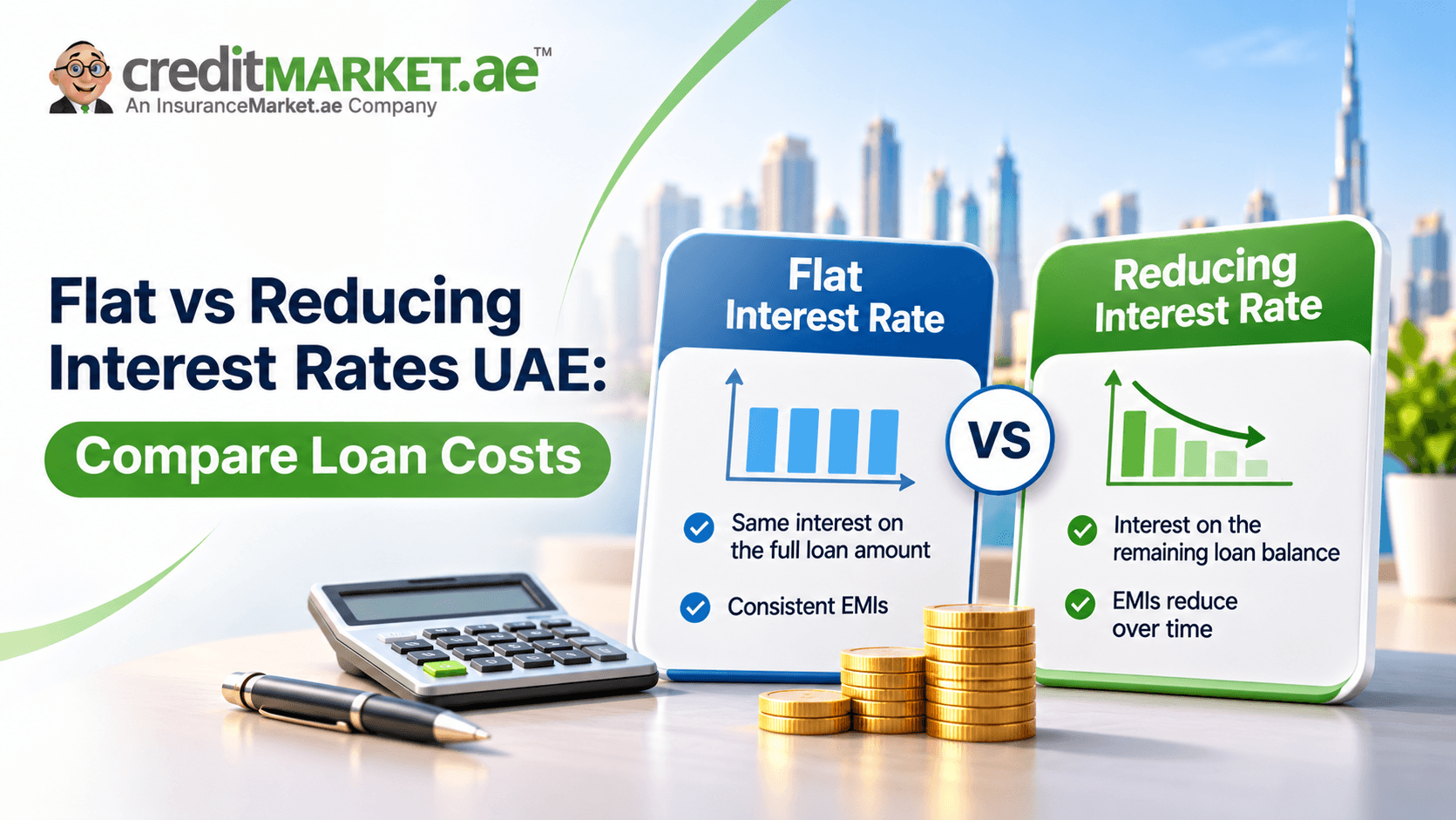
With a flat-rate loan, the bank calculates interest on the full amount you borrowed at the start. It continues using that amount even as you repay the loan.
With a reducing-rate loan, the bank calculates interest on what you still owe. As you repay the borrowed money, the amount used to calculate interest gets smaller.
This is why choosing the smaller advertised percentage won't always give you the cheaper loan. Ask each bank how much you'll pay back, including fees.
How does a flat interest rate work on a personal loan?
For a flat-rate loan, the bank works out the interest using the amount you first borrowed and how long you'll take to repay it.
Suppose you've been making payments for several months. You now owe less than you did at the start. The flat interest calculation still uses the full amount you originally borrowed.
When checking an offer, ask the bank how much interest you'll pay over the whole loan. Request that amount in dirhams, along with the monthly payment. Those figures are easier to compare than a percentage on its own.
How reducing balance interest is calculated on a loan?
With reducing balance interest, each payment repays some of the borrowed money and covers interest. The next interest calculation uses the smaller amount you still owe.
Your monthly payment can stay the same. If the rate stays unchanged and your payments are equal, less of each later payment goes towards interest. More goes towards paying back the money you borrowed.
Ask the bank for a list showing your payment dates and how much you'll owe after each payment. The bank may call this a repayment schedule. It lets you see how your debt will fall before you agree to the loan.
Is flat or reducing interest cheaper for a UAE personal loan?
You need the details of both offers to answer this. A lower flat rate can cost more than a higher reducing rate because the bank works out interest differently.
Ask both banks for offers based on the same amount of money and the same length of time to repay it. Then compare how much you'll pay each month and how much you'll pay back in total.
If one bank spreads payments over a longer time, the monthly payment may be smaller. You could still pay more interest before the loan ends.
Look for a payment you can manage alongside rent, household bills and any other debts. Check the full cost before deciding that a smaller monthly payment is the better deal.
Is a fixed interest rate the same as a flat rate?
A fixed interest rate stays the same for the period set out in your loan agreement. A flat rate tells you that interest is worked out using the amount you originally borrowed.
A loan can have a fixed rate and use a reducing balance. In that case, the percentage stays the same while the bank calculates interest on what you still owe.
Ask whether the rate stays the same until the loan is paid off. If it can change, ask when and how that could affect your monthly payment. Check what happens after any opening discount ends, too.
How to compare personal loan costs in the UAE
Before choosing a loan, get the payment details in writing. Use the same borrowing amount and the same time to repay when comparing offers.
Check how much money you'll receive
Ask whether the bank will take any fees out of the loan before paying the money into your account. If it does, the amount you receive will be smaller than the amount approved. Check this if you need the loan to pay a particular expense.
Check your monthly loan payment
Ask how much is due and on which date. Confirm whether that amount will stay the same. If a lower payment applies only at the start, ask what you'll pay after that period ends.
Ask how much you'll pay back in total
Request the full amount you'll repay by the end of the loan. Ask which fees are included and whether you need to pay anything separately.
The bank may also show an annual percentage rate, called APR. This rate includes interest and some loan fees. Ask the bank what it includes in your offer. Guidance on APR and loan costs.
Check the cost of paying off your loan early
If you expect to clear the loan before the last payment is due, ask whether the bank will charge a fee. Request the amount needed to pay off the loan at that time, including the fee
What to ask the bank before accepting a personal loan
Take these questions with you when discussing an offer:
Is the interest flat or reducing, and will the rate stay the same?
How much money will reach my account after fees?
How much will I pay each month and in total?
Are there charges I need to pay separately?
What will I pay if I clear the loan early?
Read the Key Facts Statement, the document explaining the loan's main costs and conditions. Compare it with your final offer. An advertised rate may differ from the rate the bank offers after checking your application.
If a fee or payment is unclear, ask the bank to explain it before you sign.
Compare personal loans by rate and repayment cost
Visit CreditMarket.aeto review available options, displayed rates and estimated monthly repayments. Check the rate type before comparing the percentages.
Before applying, review the selected bank's final offer and Key Facts Statement. An eligibility check is separate from final bank approval, and the bank determines the final rate and terms.


